5 Criteria to Judge If Your Chinese Name Is Memorable
Learn how to choose a memorable Chinese name that native speakers will easily remember. Discover 5 practical criteria covering pronunciation, visual simplicity, meaning, length, and cultural appropriateness.
For foreign learners planning to use a Chinese name in daily life—whether for work, study, or socializing with Chinese speakers—one key question arises: Will native speakers remember my name? A memorable Chinese name isn't just a label; it's a bridge to better communication. When your name is easy to recall, it helps you build connections faster, avoids awkward repetitions of "Sorry, could you say your name again?", and creates a lasting impression in professional and social settings.
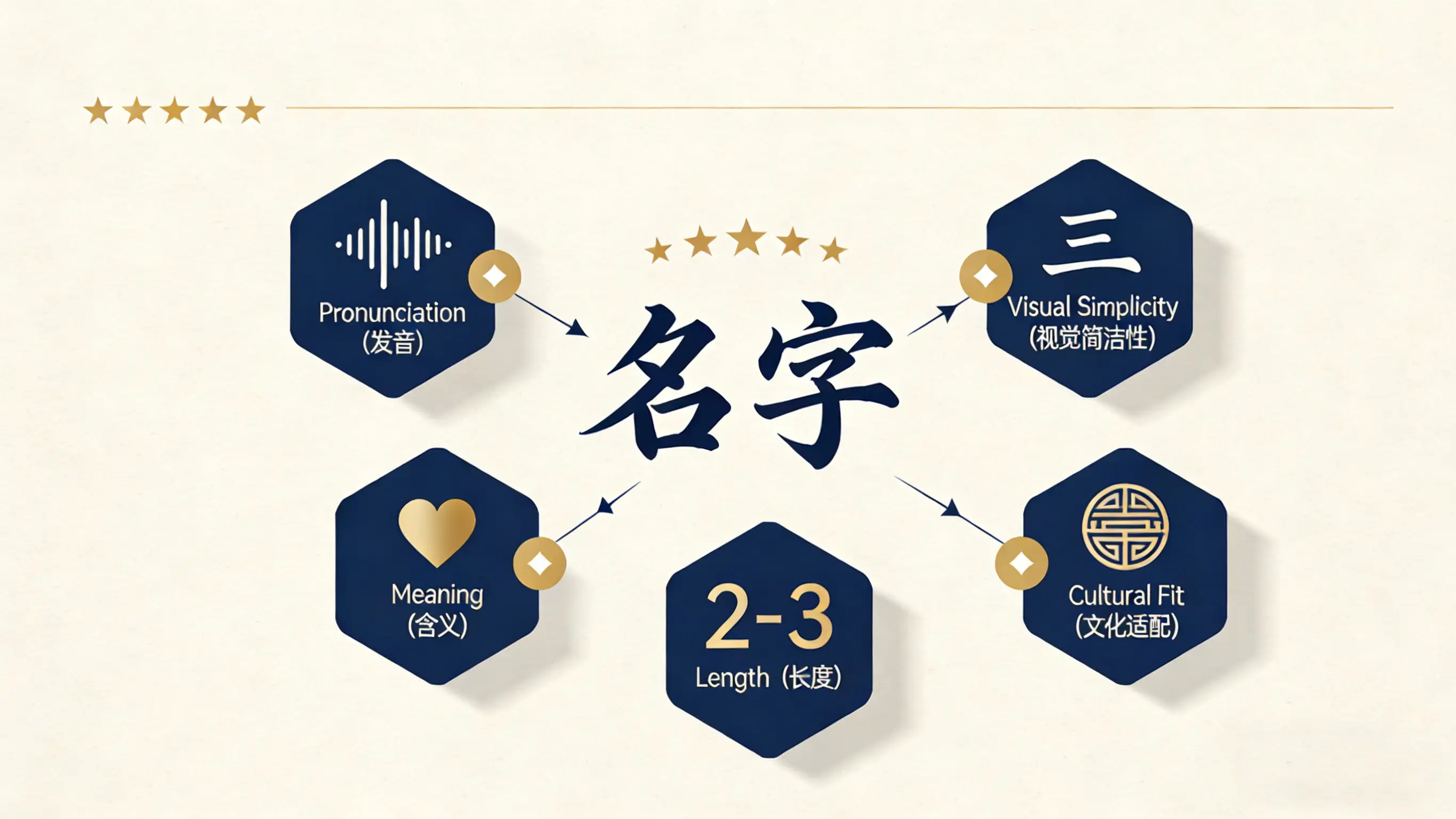
Many foreign learners struggle to choose a name that balances cultural appropriateness and memorability. This guide presents 5 practical criteria to help you evaluate whether your Chinese name is easy for native speakers to remember. These standards are based on how Chinese speakers naturally process and retain names, making them especially relevant for foreigners navigating Chinese-speaking environments.
Table of Contents
- 1. Pronunciation Simplicity and Phonetic Clarity
- 2. Character Complexity and Visual Simplicity
- 3. Clear Meaning and Positive Associations
- 4. Appropriate Length (2-3 Characters)
- 5. Cultural Appropriateness and Gender Clarity
- Balancing the Five Criteria
First, let's clarify one thing: A memorable Chinese name doesn't mean it has to be "simple" in every way. It means it's easy for others to process—whether through pronunciation, visual appearance, or meaning. Native Chinese speakers don't spend much time memorizing names; they rely on quick associations and familiar patterns. Your goal is to choose a name that fits these patterns while maintaining personal character.
1. Pronunciation Simplicity and Phonetic Clarity
Pronunciation is the first barrier to name retention. If a native speaker can't pronounce your name correctly on the first try, they'll likely avoid saying it—or forget it quickly. Chinese has four tones, but when it comes to your name, the key is balancing clarity and distinctiveness. A memorable name should have clear, easy-to-pronounce syllables and avoid confusing tone combinations.
For example, names with simple syllable structures and natural tone flows are easier to remember. Consider a two-character given name where the first syllable uses common consonants like "L", "M", "W", or "Y" paired with simple vowels like "i", "a", or "u". Tone combinations that flow naturally (such as 3rd tone followed by 2nd tone, or 2nd tone followed by 4th tone) create a pleasant rhythm that aids memorability.
On the other hand, names with repeated similar consonants or three syllables with similar vowel sounds can create phonetic blur, making them harder to recall quickly. The key is being careful with the retroflex initials "zh", "ch", "sh", and "r". These are actually among the most common sounds in Mandarin—native speakers handle them effortlessly—but many English speakers struggle to produce them cleanly, and if you can't say your own name clearly, others won't hear it clearly either. If you do prefer these sounds, pair them with simple finals (the vowel part of the syllable) like "a", "o", or "e" to keep things manageable.
Remember: The first step to being remembered is being pronounced correctly. A touch of phonetic uniqueness can make your name stand out, but not at the expense of clarity.
2. Character Complexity and Visual Simplicity
Unlike English names, which are made of letters, Chinese names are written with characters—and the way a character looks has a big impact on memorability. Think about it: When you exchange contact information with someone, they'll see your name written down. If the characters are too complex (with too many strokes), they'll have a hard time recalling how to write or recognize them later. Native Chinese speakers often associate simple, clean characters with approachability, and that association helps them remember the name.
So, how do you judge if a character is "simple enough"? A practical guideline is choosing characters with 10 strokes or fewer (in simplified Chinese). For example, characters like 小 (xiǎo, 3 strokes), 阳 (yáng, 6 strokes), 乐 (lè, 5 strokes), and 安 (ān, 6 strokes) are all easy to write and recognize. On the contrary, characters like 曦 (xī, 20 strokes), 瀚 (hàn, 19 strokes), or 麟 (lín, 23 strokes) are beautiful but overly complex. Even native Chinese speakers might hesitate when writing these characters, which means they're less likely to remember your name clearly. Imagine a colleague trying to note down your name during a meeting—if they can't write it quickly, they might just skip it, and that's a missed opportunity for connection.
Another visual factor is character structure. Characters with balanced structures (like 明 (míng), which is split evenly into 日 (rì, sun) and 月 (yuè, moon)) are easier to remember than those with lopsided or irregular structures. Balanced characters create a sense of order, which our brains find easier to store. So, when choosing your name, take a look at the characters' shapes as well as their stroke counts—simple, balanced characters will make your name more memorable visually.
Note: This guideline applies to simplified Chinese, which is used in mainland China and Singapore. If you're primarily interacting with speakers who use traditional Chinese (Taiwan, Hong Kong), character complexity may vary.
3. Clear Meaning and Positive Associations
Unlike many Western names where original meanings are often forgotten, Chinese names carry explicit meanings that significantly influence how people perceive and remember them. If your name has a vague or negative meaning, people will struggle to form positive associations—and forget it faster.
The most memorable names have simple, positive meanings that are easy to understand. For example, 静 (jìng) means "quiet" or "peaceful", 浩 (hào) means "vast" or "broad", and 丽 (lì) means "beautiful". These meanings are straightforward and evoke positive feelings. When someone hears your name, they can quickly grasp its meaning and form a mental link—for instance, "Her name means peaceful, which suits her calm demeanor." This association makes your name much more memorable. Conversely, names with rare or ambiguous meanings are hard to remember because people can't connect them to familiar positive concepts.
It's also important to consider how your surname and given name work together. The meanings should complement each other, not contradict. Ensure both individual characters and their combination convey clear, positive meanings that create a cohesive impression.
4. Appropriate Length (2-3 Characters Total)
In Chinese culture, most personal names are two characters (surname + one-character given name) or three characters (surname + two-character given name). This isn't just tradition—it's a practical choice for memorability. Names that deviate from this pattern tend to be harder to recall.
A one-character given name is common in some regions but often less distinctive. When combined with a common surname, it may blend in with thousands of others sharing the same name. This makes it harder for people to remember you specifically. On the other hand, two-character given names (making a three-character full name) offer more distinctiveness while remaining familiar to Chinese speakers. They provide space for more nuanced meaning and phonetic variety without becoming unwieldy.
Names exceeding three characters total (such as compound surnames plus two-character given names, resulting in four characters) break the familiar pattern. While not wrong, they require extra mental effort to process and remember. For foreign learners, sticking to the standard 2-3 character length ensures your name feels natural and memorable to native speakers.
5. Cultural Appropriateness and Gender Clarity
The fifth criterion addresses cultural fit and gender associations. Chinese names typically convey gender through character choice, and using characters that clearly match your gender helps avoid confusion and aids memorability. Certain characters are traditionally associated with masculine qualities (such as 勇 yǒng "brave", 强 qiáng "strong") while others evoke feminine qualities (such as 婷 tíng "graceful", 娜 nà "elegant"). While these associations are evolving, choosing characters that align with conventional gender patterns helps native speakers process your name more easily.
Cultural appropriateness also means avoiding characters with negative historical connotations, characters primarily used in older generations, or combinations that sound like common phrases or idioms in unintended ways. Additionally, be mindful of characters that might be considered too formal, archaic, or pretentious. The goal is finding a balance between uniqueness and cultural familiarity.
For foreign learners, consulting native speakers or using reliable name translation tools can help ensure your chosen name doesn't inadvertently carry unwanted connotations or violate cultural norms.
Balancing the Five Criteria
When evaluating your Chinese name, you may find that optimizing for one criterion requires compromising on another. For example, a character with beautiful meaning might have more strokes, or a very distinctive pronunciation might be harder for some speakers. The key is finding the right balance for your specific context:
- Professional environments: Prioritize pronunciation clarity and visual simplicity. You want colleagues to say and write your name confidently.
- Academic settings: Meaning and cultural appropriateness become more important, as your name may appear in publications and formal contexts.
- Social contexts: Phonetic uniqueness and positive associations help you stand out and be remembered.
Rather than achieving perfection in all five criteria, aim for a name that scores well across most of them while reflecting your personal preferences. A name that checks four out of five boxes is far more practical and memorable than struggling to meet every criterion perfectly.
Conclusion
Choosing a memorable Chinese name involves balancing pronunciation simplicity, visual clarity, positive meaning, appropriate length, and cultural fit. By evaluating your name against these five criteria, you can select a name that native Chinese speakers will easily remember and pronounce, facilitating smoother communication and stronger connections in Chinese-speaking environments.
Remember, your Chinese name is more than just a translation of your original name—it's an opportunity to create a new identity that resonates with Chinese culture while remaining true to who you are. Take time to research, consult with native speakers, and test how your chosen name sounds and feels in real conversations.
