Pinyin Initial Crisis: Is Your Name's Initial Combination Safe?
Discover why your Chinese name's Pinyin initials might be putting your digital identity at risk. Learn how to check if your initial combination is safe and what to do if it's too common.
You've been using your Chinese name for a while now. Maybe you sign messages with "WL" or "ZW", or use those letters as your WeChat username. It's convenient—just two letters instead of typing out your full Chinese name. But have you ever thought about how many other people have the exact same initials?
Pinyin initials seem harmless. You're still mastering Chinese characters, so using WL for Wang Lina or ZW for Zhang Wei feels like a small win. But this shortcut might be putting your digital identity at risk.
Pinyin is China's official romanization system - it turns Chinese characters into Latin letters. When typing characters feels slow or you can't remember all the strokes, using just the first letter of each syllable makes sense. Wang Lina becomes WL. Zhang Wei becomes ZW. Simple.
The problem? These combinations are incredibly common. Unlike Western names where J.K. Rowling's initials feel somewhat unique, Chinese surnames are heavily concentrated. Take Li (李) — one of China's most common surnames. Pair it with popular given names like Ming, Wei, Na, or Jun, and you get LM, LW, LN, LJ. Hundreds of thousands of people share these exact combinations. If you picked Li Ming as your Chinese name, congratulations, you just joined an enormous club of LMs.
This isn't just annoying, it's a security risk. Think about where you use these initials: WeChat usernames, Douban accounts, language app profiles, email signatures. When thousands of people share your initials, establishing a unique digital identity becomes nearly impossible. You might get messages meant for someone else. Your online activity could get mixed up. What's even worse, in formal settings like university applications or government documents, common initials can cause processing delays or straight-up confusion about which "LM" you are.
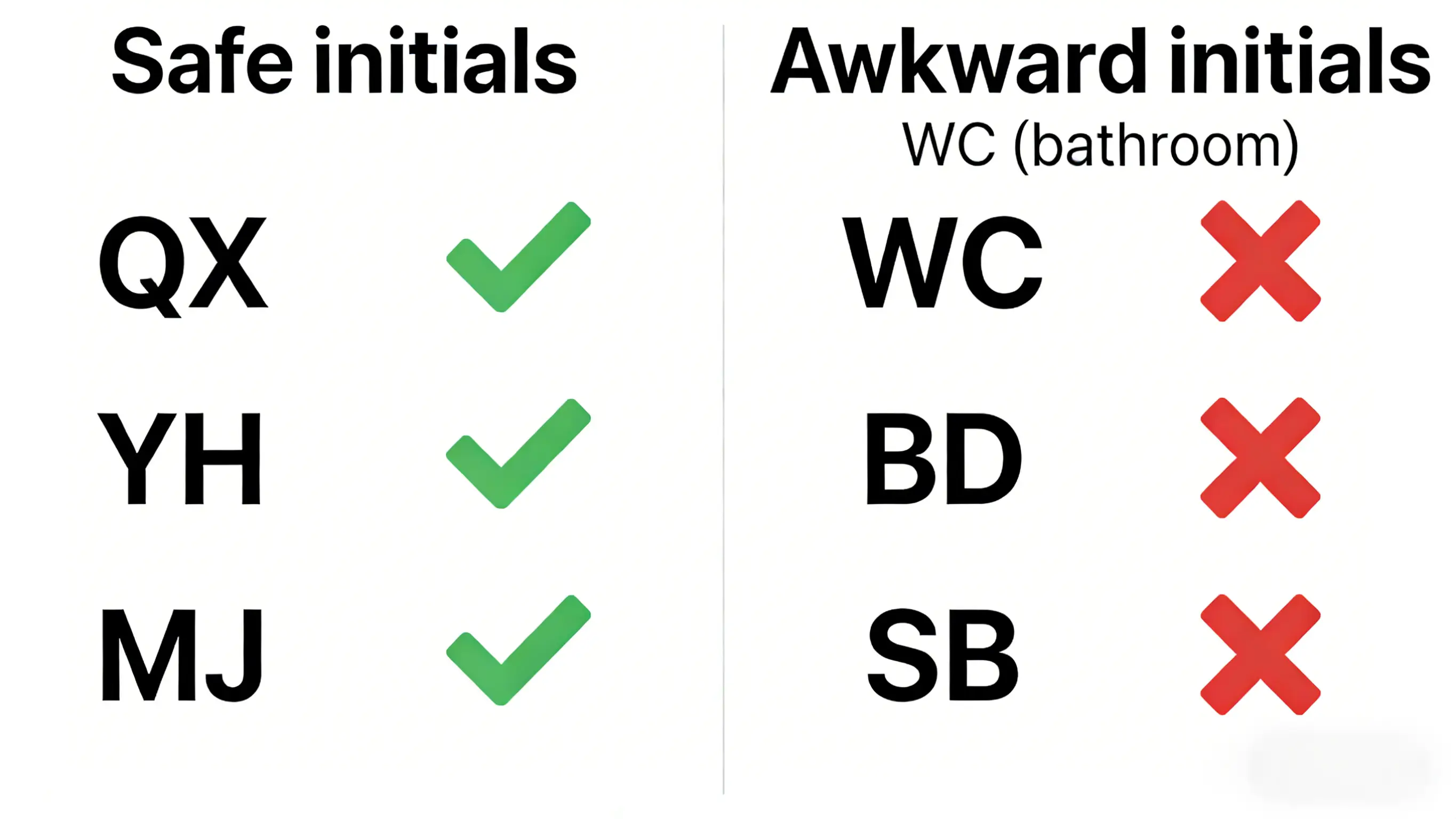
Then there's the misinterpretation problem. Some initial combinations spell out unfortunate acronyms in English. Take "WC", perfectly normal if your name is Wang Chao or Wu Chen. But WC literally means bathroom. Imagine putting that on your business card. Similarly, "BD" could read as "big deal" or worse, depending on context. These aren't dealbreakers, but they can create awkward moments you'd rather avoid.
Pinyin spelling variations make this worse. The surname Xu can be written as Hsu or Hsü in different romanization systems. Names like 英 (Yīng) and 影 (Yǐng) both become Y in initials, even though they're completely different characters. Tone marks disappear in initials. Liǎng Wén and Lǐ Wén both become LW. Even "unique" initials might not be as unique as you think.
If you used a name translator tool to pick your Chinese name, this matters even more. Most tools focus on meaning or sound, not on how common your initials will be. You might love your new name, only to find out later that you're sharing initials with thousands of others. Before committing to your Chinese name, check your initials.
How do you check if your initials are safe? Start with a simple search. Type your initials plus "Chinese name" into Google or Baidu. Chen Yu (CY)? Millions of results,that's a red flag. Qian Xue (QX)? Much rarer, probably safer. Even uncommon combinations can overlap, so don't skip this step.
Don't use your initials alone for important accounts. Add something unique: your Western name's initials, a number, a hobby-related word. Li Ming (LM) becomes "LM_learner" or "LM2024". This small change dramatically reduces confusion risk and protects your digital identity.
Context matters. Signing off "LM" to friends? Totally fine. But in formal settings such as job applications, academic submissions, government forms, use your full name with tone marks. Native speakers won't know your Western name, and common initials make you harder to identify.
If your chosen name has common initials, ask for alternatives. Love the name Wei (伟) but LW and ZW are oversaturated? Try Wei (薇) or Wei (维), different characters, same sound, but paired with a less common surname, you get safer initials. You keep the meaning and feel while dodging the initial collision problem.
When you're focused on tones, characters, and basic conversation, initials seem trivial. But as you use your Chinese name more online, offline, professionally, this "small" detail becomes significant. Identity confusion, misinterpretation, privacy issues—these risks are real.
Your Chinese name matters. It's how people remember you in Chinese circles, how you show up professionally, how you navigate Chinese platforms. Taking five minutes to check your initials isn't paranoia, it's smart. Next time you sign off with those two letters, ask yourself: are these initials actually safe? The answer might surprise you.
